
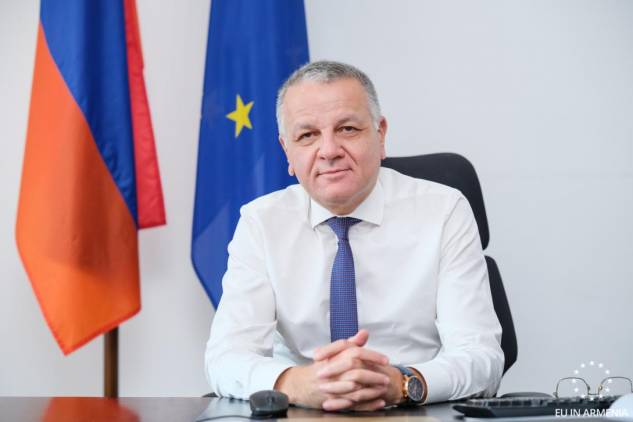
His Excellency Ambassador Vassilis Maragos – the Head of the Delegation of the European Union to Armenia has answered the questions of Hraparak daily.
- Dear Mr. Ambassador, let me start the interview by cordially thanking you for everything that the EU did and does for Armenia, especially for deployment of EUMA which is the obvious backbone of the stability and peace on Armenian Azerbaijani borders. It's absolutely gratifying and important that the mandate of EUMA was extended for another two years. However I'd like to know what conclusions were drawn from the previous two years of the mission's activity, and what changes, novelties - if any, may be applied in EUMA activities in next two years?
- I’m glad to hear your positive feedback about EU’s work in Armenia and also about the deployment of the EUMA. As we work to strengthen and deepen our partnership it is very important to build on what we have achieved together.
As regards the extension of the EUMA mandate for another two years, I would like to reassure you that the mandate will remain as strong as it has been so far. EUMA will continue to be present along Armenia’s border with Azerbaijan and thus continue to contribute to peace, stability, and human security.
Since its launch, EUMA has proven its value, becoming a key stabilising force in the region. By meticulously monitoring and reporting on developments, the Mission’s monitors have not only contributed to EU-backed peace and normalisation efforts between Armenia and Azerbaijan but has also bolstered the security and resilience of local communities. EUMA’s presence on the ground has been a critical factor in fostering a safer environment, offering reassurance to those living in border areas and reinforcing the EU’s role as a reliable partner in the pursuit of lasting peace. Let me also point out that since the deployment of EUMA the number of incidents along the border and the line of control between Azerbaijan and Armenia has significantly decreased. This is very much appreciated by the Armenian people who aspire to peace and security.
But I would like to stress that EUMA’s presence is also complementary to the broader effort of the European Union to strengthen Armenia’s resilience and sovereignty. For instance, in Syunik (one of the regions where the Mission is present) we are also implementing a comprehensive investment programme (for which we have allocated so far around EUR 150 million (more than 60 billion Armenian Drams), which focuses on education, employment, private sector and rural development, energy, and small infrastructure, which creates additional opportunities for the people in the region.
- In May, 2022 the EU adopted a document called Strategic Compass for short. This document along the establishment of civilian observing mission, also envisaged formation of EU Rapid Deployment Capacity - consisting of up to 5000 troops, to be ready for deployment beyond EU borders by 2025. These troops largely resemble an armed peace-keeping force, so I wish to ask what are the obstacles, benefits, expedience, perspectives of deploying an EU Rapid Capacity tied mission to Armenia, and have there been any discussions about it so far?
- Let me be very clear: There are no discussions in the EU to deploy a military mission to Armenia. The EU’s work on operationalising the EU Rapid Deployment Capacity is not linked to developments in the South Caucasus.
As you know, the EU adopted a first-ever assistance package for Armenia under the European Peace Facility last summer, worth EUR 10 million. This non-lethal assistance will strengthen the logistical capacities of the Armenian Armed Forces through the provision of a fully-fledged deployable tent camp. The aim is to improve the Armed Forces’ operational effectiveness and interoperability, and contribute to better protecting civilians in crises and emergencies. The implementation of this package is under way. At the same time, we have already started discussions on a second, follow-up package under the European peace Facility to further step up our support to enhance Armenia’s security, stability and resilience.
- A question if I may, about this EUROVOTE process in Armenia. It seemed me a bit unusual that the EU structures, even the euneighbourseast.eu website didn't tell a single word about the EUROVOTE campaign in Armenia when that idea was first introduced in summer 2024, nor when it turned into an initiative, nor during the signature gathering phase or afterwards. Now the draft law, lying in base of EUROVOTE, is in Parliament and had passed first hearing, so how would you assess this process from the beginning till now? Does it mean or change anything in Armenia-EU relationship dynamics?
- We welcome the positive momentum and support the closest relations. The draft law approved in first reading in the National Assembly on the launch of a process of Armenia’s accession to the EU demonstrate the attractiveness of the European Union and its values. And I would like to reassure you that in the EU there is strong commitment and consensus to continue strengthening the EU - Armenia partnership based on our common values, and interests, and our joint commitment to a rules-based international order. As regards accession to the EU, the procedures and the criteria are clear and well known, and they are triggered once a country submits and application.
Actually EU-Armenia relations have never been closer and are expanding rapidly. Next to the progress made through implementation of our existing Comprehensive and Enhanced Partnership Agreement, and work still to be done to explore its huge potential, I would like to highlight the decision to launch a visa liberalisation dialogue, the only such decision taken by the EU in the past 5 years, as well as the Resilience and Growth Plan for Armenia of EUR 270 million for the period 2024-2027, announced in April last year, which will provide targeted support to boost the country’s socio-economic resilience, as well as connectivity, businesses, trade and energy diversification, and bring Armenia closer to Europe.
- Mr. Ambassador, with your allowance, I can't help but ask a separate question about this blunt lie and falsehood disseminated from the podium of the National Assembly of Armenia that integration with EU actually means integration with Turkey. That kind of propaganda is immoral and misleading towards the Armenian people and openly hostile towards the EU. So shouldn't here follow a response from the EU - let even a mild one like declaring those MP-es, disseminating these lies persona non-grata, for example?
- The European Union is very open and transparent in its policy. This is of course also visible for the society, and the Armenian people can distinguish propaganda, disinformation and manipulation. We of course support normalisation and opening of borders between Armenia and all its neighbours including Türkiye. Any other claim beyond this is obviously false. Let me be very clear as well that the EU respects freedom of speech, this is a fundamental European and universal right.
- And my last question - perhaps the most important one - about the EU-Armenia New Partnership Agenda. Could you tell, please, how many chapters does this document contain, what are its principal differences from CEPA, and ultimately will the Partnership Agenda serve as a road-map of Armenia's path towards the EU integration or that road-map will be set by another document?
- Building on the positive momentum in EU-Armenia relations, the new EU-Armenia Partnership Agenda, for which negotiations are ongoing, will establish even more ambitious joint priorities for our cooperation across many areas: political dialogue, security, fundamental rights, economy, transport, education and employment. It will also help to unlock the significant potential of the Comprehensive and Enhanced Partnership Agreement. The New Partnership Agenda will be financially underpinned by the already mentioned EU’s Resilience and Growth Plan for Armenia of EUR 270 million for the period 2024-2027 which will support the country’s socio-economic resilience, as well as connectivity, trade and energy diversification. These documents, together with the Action Plan to be developed within the Visa Liberalisation Dialogue, will underpin our delivery in the next period, bringing indeed Armenia closer to the EU in many respects. This work will be key for our bilateral relationship and for a stable and prosperous South Caucasus region.